A literary omnibus by Moaya

Rooms
of Water

Three books in one.
A house you will never quite leave.

Talks that slow the pulse. Permissions that open a lifetime of private art. Poems small enough to carry in a pocket and large enough to carry you. This is the book you will press into the hands of everyone you love.

Rooms of WaterThe omnibus · Moaya
PROSE · POETRY · PERMISSIONSTake your time

Inside Rooms of Water

Water, permission,
and weather.

Few books dare to hold this much: the diagnosis and the cup of tea, grief and laughter in the next room, the breath you never had to ask for. Rooms of Water holds all of it in one volume, and still leaves the door open.

They are gathered here because they kept asking the same question in different voices: what do we do with what we cannot keep?

The river talks it through. The permissions hand the question to you. The poems set it on a table and leave the room.

From “A Note on This Volume”

Within the volume

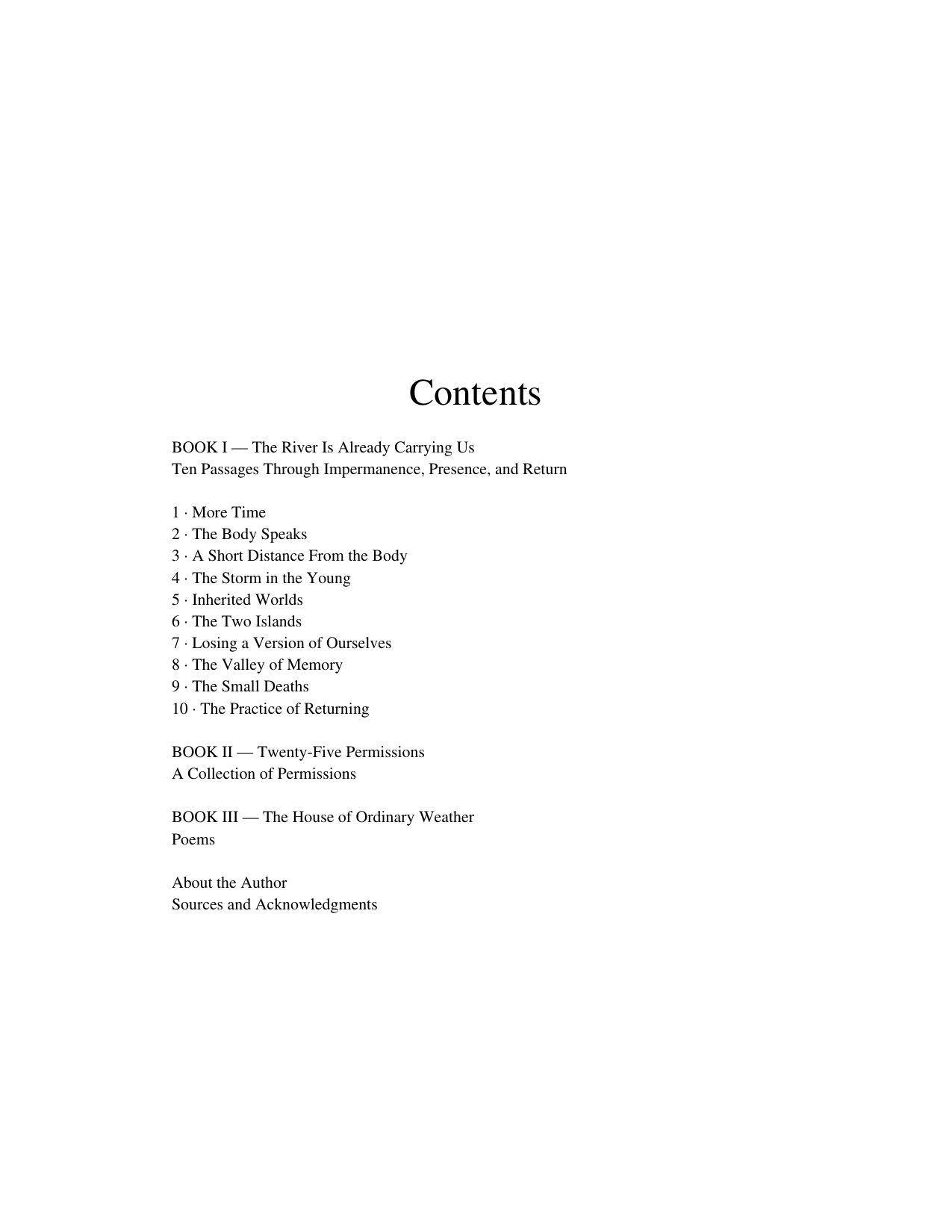
  1. The River Is Already Carrying UsTen passages to read aloud, slowly, and come back to for the rest of your life.
  2. Twenty-Five PermissionsTwenty-five doors left unlocked. Walk through any one of them and you will not come back the same.
  3. The House of Ordinary WeatherThirty-nine poems, each a single room, each lit from within.
From the omnibus

It does not say, “Do not love, because you will lose.”
It says, “Love more completely, because you will lose.”

From “More Time” · The River Is Already Carrying Us · Moaya

A reader’s overview

One body of work,
three densities

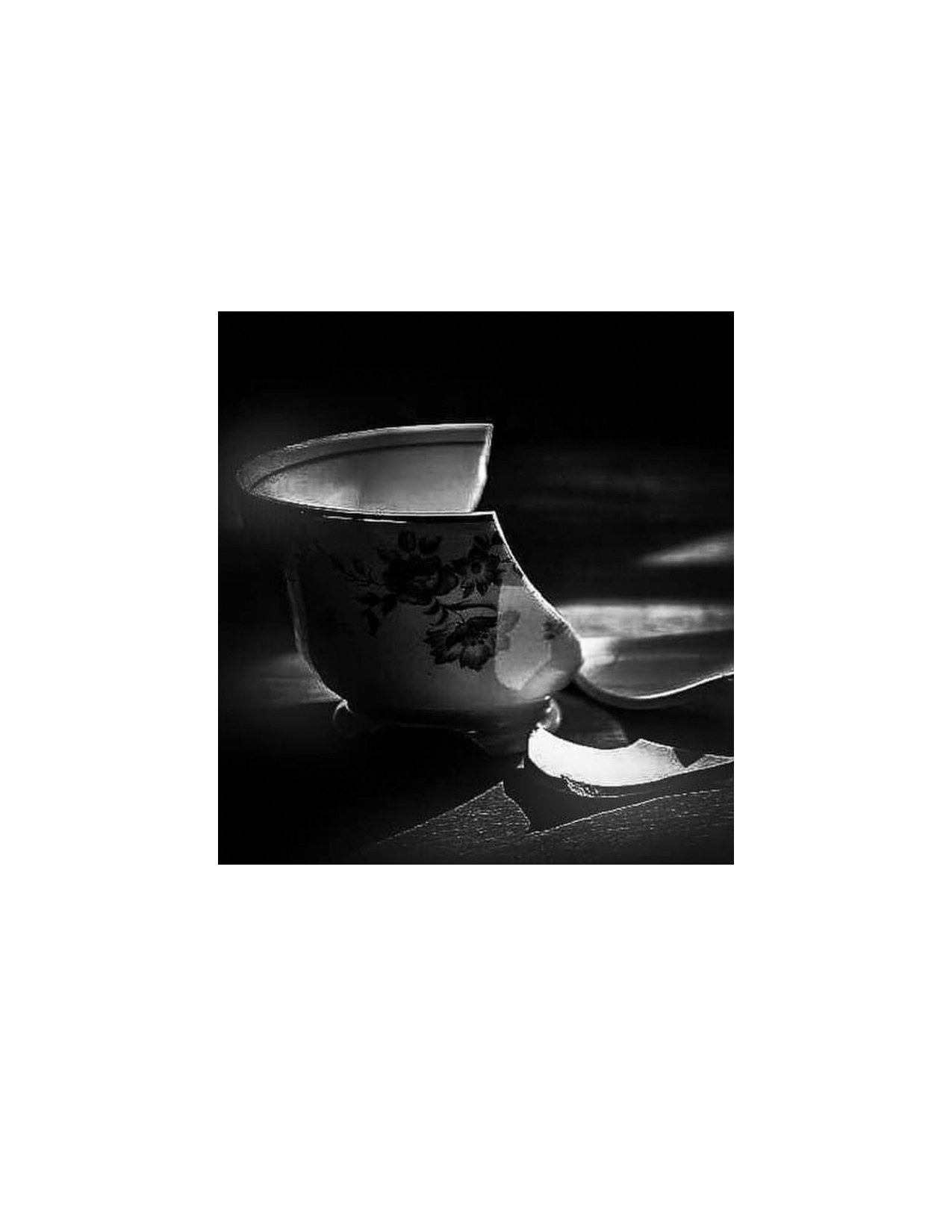
Rooms of Water is that rare book that rewards every kind of reader: the one who reads straight through in a night, and the one who keeps it by the bed for years. It is best read as one body of material passed through three forms. The same images return across its books: a cup of tea cooling by a window, a chair left behind when someone goes, a breath, a diagnosis spoken in a room. What changes from book to book is how much is said about them, and who is asked to finish the thought.

Book I The talk

The River Is Already Carrying Us

The ten passages are written to be spoken, in the cadence of a talk given to people sitting together in a room. The first begins, “Today I want to speak about something many of us carry quietly.” They draw on the plain, common language of contemplative teaching but ask for no shared belief. What holds them together is attention rather than doctrine. Autobiography enters the talks: a camera that taught the speaker to stand “a short distance away,” a birth in West Germany while the country was divided, Choctaw and Jewish inheritance. The borrowings are named. The third passage takes its title from Joyce’s Mr. Duffy, who “lived at a little distance from his body.”
Book II The permission

Twenty-Five Permissions

The permissions descend from the event score, the brief text instruction George Brecht developed in John Cage’s class in 1958–59, which became a central Fluxus form. Brecht allowed that a score could be performed publicly, privately, or not at all (George Brecht). Yoko Ono’s Grapefruit, self-published in Tokyo in 1964 in an edition of 500 (Grapefruit), went further: some of its instructions can be carried out only in the mind (Tate).

Moaya changes the grammar from command to allowance, and turns the impossible toward grief. Where Ono writes “Light a match and watch till it goes out,” Moaya asks for “the dream you did not have,” or a voice “as it sounded in a room you no longer live in.” By the end the list turns on itself (“Do it last. Do it first.”), so leaving it unfinished becomes part of the form.

Book III The poem

The House of Ordinary Weather

These poems test a sentence from Gaston Bachelard’s The Poetics of Space: “the house shelters daydreaming, the house protects the dreamer, the house allows one to dream in peace” (CBC Ideas). Critics have read Bachelard’s sheltering house as a response to an uneasy modern world (Harvard Design Magazine). Moaya’s poems let that unease inside. A diagnosis arrives and “all the chairs / turn toward it.” At dinner the bread is passed “around a wound.”

Most of the poems hold a single image, closer in scale to haiku than to the lyric. The last three break that scale: a man of salt waiting for rain, a vacuum cleaner in a felt hat, a moon dragging a chair through grass. Here the book’s roots in Dada and Surrealist poetry come to the surface, and the house begins to dream on its own.

Across the volume Echoes

Read together, the books work less as a sequence than as a set of echoes. In Book I, fear “may come to sit beside the heart like a difficult guest.” In Book III, “Fear sits / at the kitchen table. / I give it water.” The old resentments the talks call “cargo” become a short poem in which resentment finally “asked to be / put down.” A two-page meditation on the family table shrinks to a three-line poem about bread. Part of the pleasure of the omnibus is catching a sentence from one book compressed into an image in another.

Context Further reading

What readers are saying

Praise for
Rooms of Water

“Rooms of Water offers a whimsical, and poignant, reflection on questions addressing the many existential curiosities, we all grapple with. Approachable prose, written for all ages to delightfully ponder.”

Lorraine Hedtke, MSW, ACSW, PhDAuthor of Love in the Face of Grief

“I’m still thinking about the permissions. Some of the permissions resonated— more like the twang of a guitar (sitar?) string perfectly in tune while others shimmered in a drizzle or a chunk of wood not yet carved into the instrument.

There is the thread of weather and constant change, the impermanence of any one state, that run through it all. And listening, I hear the wind, smelling, that’s dawn or dusk with tea pots and loneliness. So many sighs and always back to the breath.”

Danielle A. DurkinPoet, Editor, MFA The New School for Social Research

“In life i need to recapture the stillness Moaya’s words brought as they unfolded up to me from the page. In the swirling chaos of our now, an anchoring mantra.”

Cory Mac a’GhobhainnArtist, Animal Rights Activist, Earth Resident, MFA Hunter College

A note from Moaya

On Rooms of Water

In the mid-1970s, I studied painting and figure drawing with abstract expressionist Don Stacy in his East Village loft before following him to the New School. That experience is part of what I bring to Rooms of Water, where writing and art-making meet through poems, prose, and permissions.

I’m also drawn to Fluxus, to its opening between ordinary action and art, and to Yoko Ono’s way of making a few words become an experience entirely in the mind. In this omnibus, I bring those possibilities into a sustained, personal offering.

There is a teaching here, but I want the writing to carry it. It begins with paying attention and trying to meet ourselves and one another with less harshness. It asks for no shared belief. These are things I’m still learning to live, not things I’ve settled.

My emphasis is on permission: something the reader can take into their own life, change, refuse, or leave unfinished. I don’t need to know what happens. Whatever they find can belong to them.

I want to offer beauty and consolation without pretending things are all right. I’m putting something of myself into these pages, hoping someone might feel less alone.

Moaya

Bring the work home

A book to keep.
And one to give away.

Rooms of Water is an artist-made literary omnibus, designed page by page by Moaya. The spacing, the silences, the photographs, the way one piece gives way to another: every inch of it is part of the work. This is the kind of book that outlives its first reader and goes on to find its next.

The first hardbound printing is limited to 100 copies. When they are gone, they are gone.

Photographs of the printed edition will follow.

The maker & the press

Sitten’ in the Donüte Pocket Press

Made with attention.
Offered with room.

Moaya Scheiman, who publishes as Moaya, is a writer, filmmaker, photographer, visual artist, food historian, chef, and independent book-maker. Rooms of Water pours a lifetime of looking closely into the space of a single book.

Published by Sitten’ in the Donüte Pocket Press.
Petaluma, California.